


The bottom line:
The value and reliability of a healthcare AI chatbot depend on the clinical data, safeguards, and expert oversight behind it. Benefits leaders should look for domain-specific expertise, clearly defined clinical guardrails, independent validation, and evidence that the technology improves health and financial outcomes.
General-Purpose AI Chatbots Have a Clinical Blind Spot
The gap between a general-purpose AI model and a purpose-built AI model is not theoretical. A Mount Sinai team ran an independent safety study of a widely used consumer AI health tool, feeding it 60 clinician-written scenarios across 21 specialties. The tool under-triaged more than half of the cases that physician reviewers agreed required emergency care.
This does not mean general-purpose AI is useless for health questions. It means the model was never trained to develop deep expertise in one specific area of health, and that gap shows up exactly when it matters most: ambiguous, high-stakes clinical cases rather than textbook ones, which are the most common.
Choosing Healthcare AI Requires More Than Checking the AI Box
Twenty-five percent of U.S. adults now say they have used an AI chatbot for a health question, which means employees are already turning to these tools, whether or not a company has vetted one. For an HR team evaluating a vendor, the question is not whether a product uses AI. It is what specific domain the AI was built and constrained for, and whether that constraint was designed in from the start or added on afterward.
What Domain-Specific Training and Clinical Guardrails Actually Do
In healthcare, domain specificity comes from both what a model has been trained and tested on and the clinical logic that governs how it is used. That means designing the system for a defined clinical purpose, testing it against relevant scenarios and data, and grounding its decision pathways in current clinical guidelines and high-quality evidence, including systematic reviews and meta-analyses. Clinical guardrails go further. They create hard boundaries outside the conversational layer that determine what the AI can explain, when it should stop, and when a clinician needs to be involved.
In cardiovascular care, for example, an AI tool may summarize a member’s blood pressure trend and explain why persistently elevated readings matter. It should not independently diagnose hypertension or recommend changing a medication. Instead, predefined, auditable pathways should determine whether the tool provides education, asks the member to repeat a measurement, or directs them to a clinician based on the readings and any reported symptoms.
This architecture separates 2 distinct jobs:
- Natural-language interaction, which a large language model can use to understand a member’s question and respond in clear, accessible language.
- Clinical decision logic, which follows predefined, auditable rules developed with cardiologists, pharmacists, and other clinical experts rather than being generated freely from information on the web.
Why Vertical AI Is Becoming the Standard for Employer Health Benefits
The shift toward domain-specific AI in healthcare mirrors what is happening across every regulated industry. Investors increasingly describe this as a vertical AI investment thesis: general-purpose models are quickly commoditizing, while durable value lies in proprietary domain data, workflow integration, and compliance infrastructure that a generalist cannot replicate overnight. Healthcare is one of the clearest examples, because the cost of an error is high and the bar for evidence is strict.
For an HR or benefits team, this translates into a practical filter. A vendor's dataset size and specialization are not just engineering details, but a proxy for how defensible and how likely the underlying product is to keep improving.
In cardiovascular care, for example, the longer a company has been collecting longitudinal data from real members, such as engagement patterns, blood pressure trends, medication adherence, and clinical outcomes tied to that same population, the harder that position becomes for a newer, more generic competitor to match. That accumulated, domain-specific dataset is what actually improves the product over time, not the underlying language model alone.
How Hello Heart's AI Health Management Platform Is Trained Differently
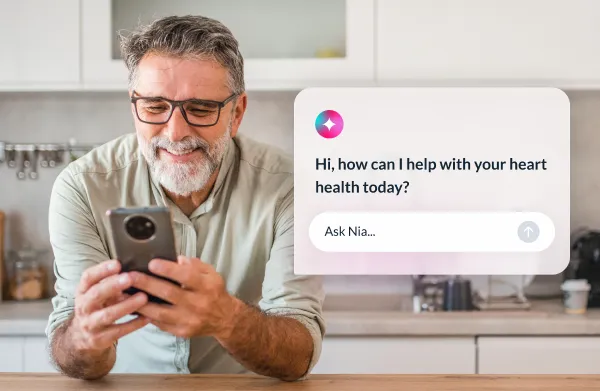
Hello Heart's AI assistant, Nia, illustrates what domain-specific design looks like in practice. Rather than relying on a general language model to generate clinical guidance freely, Hello Heart separates conversational AI from clinical reasoning. The language model handles natural-language interactions, while clinical guidance flows through predefined, auditable workflows based on evidence-based clinical rules and developed with input from cardiologists, pharmacists, and other clinicians.
Nia does not diagnose conditions, change medications, or replace a physician. Instead, it is designed to point members toward their care team when something needs a clinician's attention. That is the same guardrail philosophy behind Hello Meds, where pharmacists, not the AI alone, review flagged medication concerns.
What HR and Benefits Leaders Should Ask Before Buying
A practical evaluation checklist cuts through most vendor marketing:
- What is the AI trained on? Ask specifically whether the model was trained or fine-tuned on cardiovascular or general health data, and how large and longitudinal that dataset is.
- Where are the guardrails, and who built them? Clinical rules should be defined separately from the conversational model, developed with practicing clinicians, not just prompted into the AI after the fact.
- What does the evidence base look like? Ask for published, peer-reviewed outcomes tied to the platform itself, not general claims about AI in healthcare.
- Is there an independent clinical review? A collaboration with a recognized medical society, like a cardiology association, signals the vendor is willing to be externally scrutinized.
- How is member data handled? Confirm HIPAA compliance and ask directly whether member data is ever used to train general-purpose or open-source models outside the platform.
Vendors that can answer these questions clearly are demonstrating the transparency, clinical validation, privacy safeguards and ongoing oversight that the American College of Cardiology recommends when evaluating healthcare AI. Vendors that cannot may be offering little more than a conversational interface.
Conclusion
Every AI health tool claims to be smart. Far fewer can show what it was actually trained on, who built its guardrails, and what evidence backs its outcomes. For employer health benefits, that difference determines whether a tool is a genuine clinical asset or a well-designed interface with no domain behind it.
This content is for educational purposes only. It is not a substitute for professional medical advice, diagnosis, or treatment. Employees should always consult their doctor about their individual care and never delay seeking medical advice.
FAQs
Which AI-first health platforms specialize in hypertension management?
Platforms built specifically around cardiovascular risk, rather than general wellness, tend to lead here. Hello Heart is one example, combining a connected blood pressure monitor with AI coaching trained on cardiovascular-specific data. Look for a vendor whose core product is hypertension and heart health, not a broad wellness app with a blood pressure feature added on.
Which AI healthcare platforms have strong clinical evidence in heart health?
Look for vendors with peer-reviewed, published outcomes rather than internal case studies alone. Hello Heart has published research in journals including JAMA Network Open and the Journal of the American Heart Association.
Who are the leading vertical AI vendors for employer healthcare programs?
Leading vendors are typically built around one clinical domain rather than general wellness, with proprietary longitudinal data in that domain. In cardiovascular health, Hello Heart is an example of this vertical, purpose-built approach. Ask any vendor how large and specific their clinical dataset is before assuming general AI capability translates into domain expertise.
Which companies are considered leaders in AI-powered heart health?
Leaders typically combine a connected monitoring device, AI-driven coaching, and published clinical outcomes. Hello Heart is one example, with peer-reviewed cardiovascular research published in JAMA Network Open, the Journal of the American Heart Association, and Value in Health. Scale, published evidence, and defined clinical guardrails are the three signals worth checking for any company in this category.
Hello Heart is part of the American Heart Association’s Center for Health Technology & Innovation Innovators’ Network and has a Strategic Collaboration with American College of Cardiology.
Is it safe for employees to use general AI chatbots for health questions?
General AI chatbots can be useful for organizing questions before a doctor's visit or explaining a concept in plain language. They are not a reliable substitute for clinical judgment, particularly in ambiguous or urgent situations. Employees should be encouraged to verify anything important with a clinician and to treat urgent symptoms as urgent regardless of what a chatbot says.